

KLOW
KLOW
$185.00
Quantity
Description
This advanced peptide formulation represents a significant innovation in regenerative science. BPC‑157 contributes gastrointestinal protection and angiogenic support, GHK‑Cu drives collagen remodeling and provides antioxidant defense, TB‑500 enhances actin regulation and cellular migration, while KPV delivers potent anti‑inflammatory activity. Together, these components establish a multi‑layered strategy for tissue repair. Their synergistic interplay not only amplifies individual benefits but also opens new avenues for therapeutic exploration. This blend is of particular interest to researchers studying complex healing processes that demand coordinated cellular responses across multiple biological systems.
Additional Information
Weight: 0.08 lbs
Dimensions: 0.87 × 1.18 × 0.87 in
Size: 5mg, 10mg
This product is intended solely for research purposes. It is not authorized for use in humans or animals and should only be handled by trained personnel in appropriate laboratory settings.
Highlights
Physicochemical Attributes
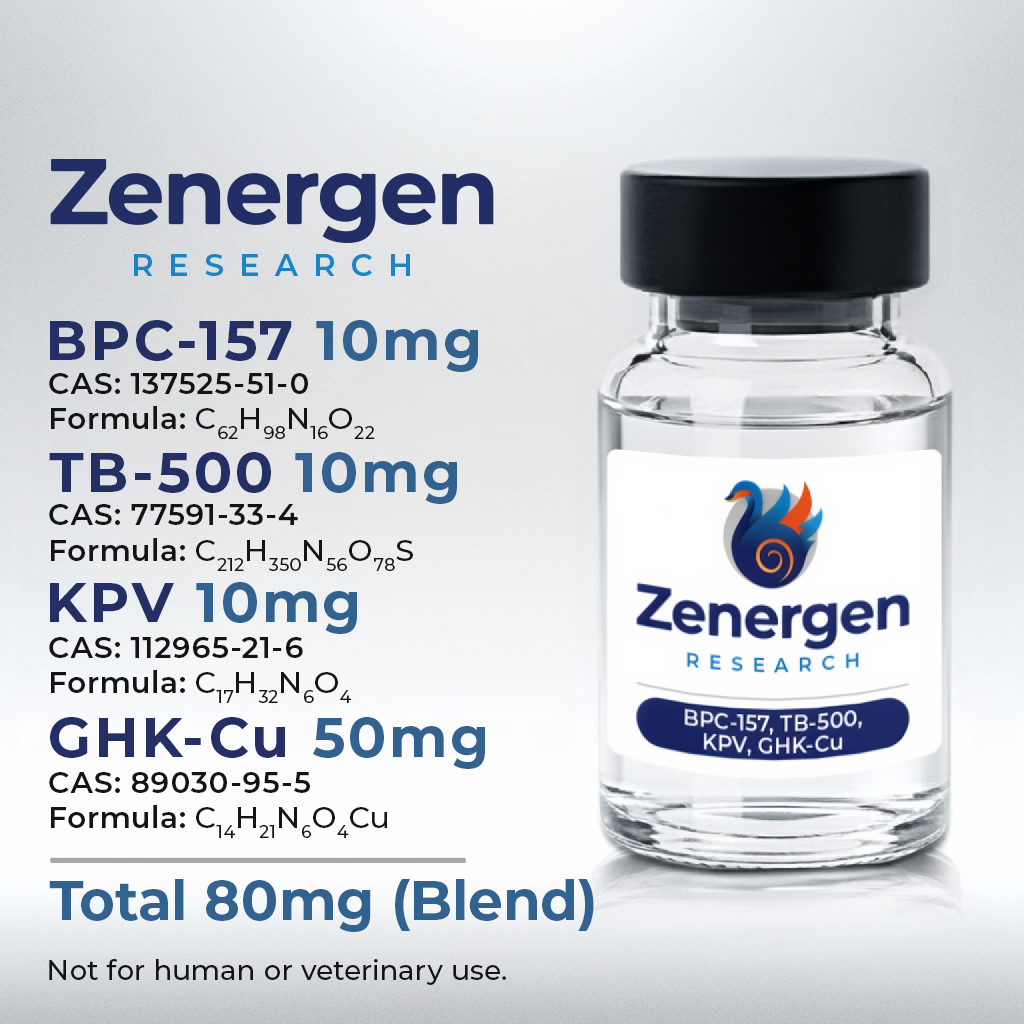
Aggregate Weight: 80 mg combined peptide formulation
Appearance: Lyophilized powder preparation
Coloration: White to off‑white with a faint bluish hue (from GHK‑Cu)
Preservation: Store refrigerated at 2–8 °C (36–46 °F)
Peptide Constituents
BPC‑157: 10 mg (Body Protection Compound)
GHK‑Cu: 50 mg (Copper‑binding peptide)
TB‑500: 10 mg (Thymosin Beta‑4 derivative)
KPV: 10 mg (Anti‑inflammatory tripeptide fragment)
Biological Mechanism
The peptide combination engages multiple mechanisms, delivering amplified tissue repair potential:
Individual Peptide Roles
BPC‑157 Contributions
Stimulates angiogenesis, modulates growth factors, regulates nitric oxide pathways, and coordinates systemic repair processes.
GHK‑Cu Functions
Drives collagen production, provides antioxidant defense, influences gene expression, and supports tissue restructuring.
TB‑500 Activities
Facilitates actin binding, enhances cellular migration, reduces inflammation, and contributes to cardiac resilience.
KPV Benefits
Delivers strong anti‑inflammatory activity, fortifies intestinal barrier integrity, modulates immune response, and exhibits antimicrobial potential.
Synergistic Interactions
Amplified Angiogenesis
BPC‑157 and TB‑500 act in concert to accelerate vascular formation.
Integrated Anti‑inflammatory Response
KPV’s precise activity complements the broader inflammation‑reducing effects of the blend.
Structural Matrix Remodeling
GHK‑Cu’s collagen synthesis aligns with TB‑500’s cellular organization for enhanced tissue architecture.
Expedited Healing Course
The combined actions may substantially shorten recovery timelines.
Research Highlights
This formulation paves the way for innovative directions in regenerative medicine studies:
Integrated Tissue Regeneration
Multi‑pathway healing strategy:
• Accelerated closure of wounds and minimized scarring
• Strengthened musculoskeletal recovery
• Enhanced restoration of organ tissues
• Synergistic impact on overall repair timelines
Advanced Anti‑Inflammatory Research
Diverse mechanisms of inflammation regulation:
• Downregulation of inflammatory markers
• Defense against chronic inflammatory states
• Maintenance of intestinal barrier integrity
• Broad systemic anti‑inflammatory activity
Cardiovascular Support
Combined cardiac advantages:
• Augmented cardiac tissue repair (TB‑500 + BPC‑157 synergy)
• Improved vascular function via GHK‑Cu’s antioxidant properties
• Reduction of cardiac inflammation through KPV activity
• Investigations into post‑injury cardiac remodeling
Neuroprotective Exploration
Emerging neurological applications:
• Coordinated neuroprotective outcomes
• Increased potential for nerve regeneration
• Attenuation of neuroinflammation
• Prospects in neurodegenerative disease models
Possible Research-Related Effects
Important factors for blend research:
Dose Determination
Ratios between components must be factored into experimental dosing strategies.
Stability Evaluation
The characteristic blue hue from GHK‑Cu serves as a visual marker of solution integrity.
Synergy Analysis
Studies should be structured to compare combined activity versus individual peptide effects.
Reconstitution Guidelines
Precise reconstitution is necessary due to differing solubility profiles among the peptides.
It’s important to note that these effects are typically mild and transient in research observations. However, comprehensive long-term safety data is still being collected.
Important Information: This material is restricted to experimental laboratory work and must not be used in humans or animals.
References
BPC 157 therapy in inflammatory bowel disease: Clinical evidence. Biomedicines, 2024. — Tepes B, et al.
GHK‑Cu: Updated research on tissue remodeling and anti‑aging. Int J Mol Sci, 2023. — Pickart L, Margolina A.
Thymosin β4: Mechanisms and therapeutic applications in regeneration. Int J Mol Sci, 2023. — Pipes GC, Yang J.
KPV peptide nanoparticles for inflammatory disease treatment. J Control Release, 2024. — Zhang C, et al.
Combinatorial peptide therapies for enhanced tissue regeneration. Adv Drug Deliv Rev, 2023. — Lee HJ, et al.

About Us
Zenergen Research Products is committed to supplying high-purity peptides intended for research use, with an emphasis on quality control and dependable delivery.
Contact Us
Copyright© 2026 Zenergen Research - All Rights Reserved.
All products offered by Zenergen are intended strictly for laboratory research purposes only. These compounds are not authorized for human or veterinary use and must be handled exclusively by qualified professionals in controlled research environments. They are not intended for diagnostic, therapeutic, or clinical applications. Statements made on this website have not been evaluated by the U.S. Food and Drug Administration.